
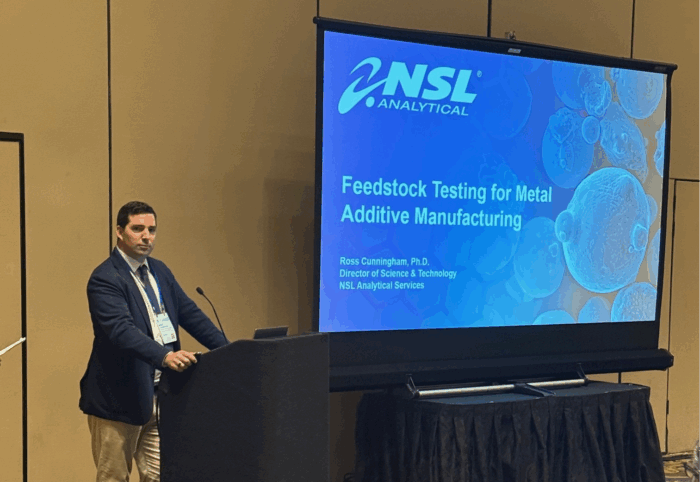
On October 6, 2025, NSL’s Dr. Ross Cunningham presented at the ASTM International Conference on Advanced Manufacturing (ICAM) in Las Vegas. Dr. Cunningham joined more than 1,100 scientists, engineers and industry leaders from 35 countries who attended the flagship event for additive and advanced manufacturing. Below is a summary of Dr. Cunningham’s presentation.
In a little over a decade, Additive Manufacturing (AM) has transitioned from a niche prototyping tool to a viable production technology for components used in aerospace, defense, and medical applications. While improvements in design principles and process controls have enabled broader adoption, material-related challenges remain one of the most challenging barriers to significant advancement, particularly as engineers are increasingly looking to AM for mission-critical parts operating in extreme environments, like rocket and jet engines.
As AM technologies aggressively push towards maturity, it is clear that the approaches that enabled early progress will not be sufficient for the next tier of performance and reliability, where the demands and challenges related to materials are stronger than ever. To put it simply: what got us here won’t get us there.
Significant progress has been made in controlling microstructure and defects in commonly used AM alloys such as AlSi10Mg, Ti-6Al-4V, and CoCr. However, trace-level material chemistry and contamination have historically received less attention, despite their profound impact on material performance.
A notable exception is Ti-6Al-4V, where oxygen content plays a critical role in material qualification and differentiates Grade 23 from Grade 5 (≤0.13 vs 0.2 wt%). Oxygen levels strongly influence mechanical properties, making this parameter tightly controlled in aerospace and medical applications.
For many other alloys, even small concentrations (<1000 ppm) of certain elements can significantly alter performance. For example:
These sensitivities were historically managed through specially designed, tightly controlled processes such as vacuum investment casting, but AM introduces new exposure pathways that increase contamination risk.
The use of powder feedstock for many metal AM provides a lot of flexibility to those processes, but adds complexity to material control. Fine powders possess high surface area, making them more susceptible to gas absorption — particularly oxygen and nitrogen — than cast or wrought forms. Economic and sustainability drivers further encourage powder re-use, amplifying the potential for contamination from poor handling or cleaning practices, as well as gradual chemical drift over time.
While powders are frequently used in traditional manufacturing processes for critical and highly regulated components, such as powder metallurgy alloys used in rotating hot-section jet engine components, the risks are real. A high-profile case in 2023 saw an engine manufacturer incur a $3 billion charge related to undetected powder contamination.
The opportunity for AM in critical applications is significant, but so are the material challenges associated with powder-based processes — reinforcing the importance of robust feedstock quality control and testing.
Two of the most widely used techniques for detecting elemental composition in AM powder feedstock are:
These methods are particularly well-suited for powder materials, which are incompatible with other elemental analysis techniques such as spark-OES.
Sample Preparation Considerations
Both techniques require dissolution of a measured sample mass into an aqueous solution, typically using heated acids. Proper digestion is essential and demands experienced chemists, especially for corrosion-resistant or complex alloys. Incomplete or improper preparation can lead to significant errors due to precipitation or volatilization of elements.
Analysis Process
After preparation, the sample is introduced into a high-temperature plasma, where the sample is vaporized and constituent atoms ionized. The two methods differ in how they detect and quantify those ions:
When used together, ICP-OES and ICP-MS provide a comprehensive chemical profile across approximately 70 elements, spanning bulk to trace levels, offering robust insight into powder chemistry. Further, unlike other methods such as Spark-OES or XRF, they don’t require certified reference materials.
Key Considerations for Accurate Trace Element Testing
While powerful, ICP methods are not without limitations. Critical factors influencing accuracy include:
Understanding these limitations — and working with an experienced testing laboratory — is essential for generating reliable, actionable data.
LECO analysis provides essential insight into non-metallic and interstitial elements that are impossible or impractical to measure through ICP techniques, such as oxygen, nitrogen, carbon, and sulfur. There are a few techniques that fall under the category of LECO testing:
Together, these methods enable highly sensitive measurement of elements that play a critical role in many material properties, often at low concentrations. As with ICP, these are robust methods that can characterize a wide variety of materials with wide detection windows for their target analyte. However, certain materials — such as aluminum, magnesium, and precious metals — can present added complexity.
Key Considerations for LECO Testing
Scanning Electron Microscopy (SEM) is a powerful tool for assessing the physical characteristics of AM feedstock, including particle morphology, size distribution, and contamination.
When paired with Energy Dispersive Spectroscopy (EDS), SEM can also perform localized, semi-quantitative elemental analysis of individual particles. This capability is particularly valuable for identifying surface contamination and foreign-body contamination. This is one of the main uses for powder, as small amounts of foreign-body contamination (such as refractory particles from the powder manufacturing process) cannot generally be detected through bulk analysis like ICP or LECO.
However, SEM/EDS has some limitations as a quality control tool and is not a replacement for quantitative trace-level elemental analysis. Challenges include ensuring representative sampling, differentiating signal from noise at low concentrations, and the inherent limitations of detecting light elements. Additionally, elemental mapping and contamination analysis are often labor-intensive and time-consuming processes.
Key Considerations for SEM Analysis
Moisture plays a critical role in powder behavior and final part quality. Water readily adsorbs to the oxide layer of metal powders, contributing to oxidation, gas porosity, reduced flowability, and downstream performance issues.
Karl Fischer (KF) Titration is the industry gold standard for moisture measurement in AM feedstock, using the oven desorption technique. This approach enables accurate quantification of moisture across a broad range, typically as low as ~10 ppm.
For an in-depth look at Karl Fischer Titration, see our webinar on Karl Fischer analysis for AM Powder.
Key Considerations for Moisture Testing
Another challenge of using powder feedstocks in AM is that while all of the above-mentioned chemical and material requirements are critical to the properties of the end-part, getting the feedstock to behave in a predictable manner is equally critical to the success of the manufacturing process. Tests for essential powder characteristics like packing density and flow have been around for decades, but new metrics like spreadability are unique to AM. New tools and methods are being developed to characterize these properties and give insights into how the multitude of measurable powder properties affect behavior in the AM process.
One such method is dynamic avalanche rheometry. This method uses a rotating drum powder rheometer that evaluates dynamic flow by recording how the powder tumbles, shears and cascades under rotation and vibration. This test provides key information on the powder’s flowability in a measurable form, giving more insight into how they will behave in the AM process compared to traditional characterization techniques.
As additive manufacturing continues its evolution into higher criticality applications, material considerations like controlling chemistry at the trace level are no longer optional — they are fundamental. Fortunately, many of the tools and techniques to address these challenges are well-established, and new ones are rapidly advancing.
By pairing awareness of contamination risks with robust analytical methods such as ICP-OES and ICP-MS, manufacturers can significantly improve confidence in their feedstock, enhance process consistency, and ensure the performance of AM components in the most demanding environments.
Looking to dive deeper into how third-party testing can support your unique material needs? Check out NSL’s resources below:
Materials Matter: This educational hub page is a trusted resource for material science information.
Webinars and White Papers: Dive into specific topics in this library of educational webinars and white papers.
Video Library: View these helpful videos about everything from additive manufacturing to spectroscopy and more.
NSL Analytical Services, Inc. is an independent materials testing lab that specializes in metallurgical, mechanical, chemical, and optical testing for mission-critical industries.
Contact our experienced, accredited team to discover how we can deliver accurate, repeatable testing results with lightning-fast turnarounds, giving you confidence in your material performance and adherence to quality standards and regulations.

Dr. Ross Cunningham has more than a decade

Dr. Ross Cunningham has more than a decade

Ben Pratt is the Business Development Manager –



NSL Analytical
4450 Cranwood Parkway
Cleveland, OH 44128
(216) 438-5200
(216) 438-5050
NSL Metallurgical
4564 Johnston Parkway
Cleveland, OH 44128
(877) 560-3943
NSL Analytical
4450 Cranwood Parkway
Cleveland, OH 44128
(216) 438-5200
(216) 438-5050
NSL Metallurgical
4564 Johnston Parkway
Cleveland, OH 44128
(877) 560-3943