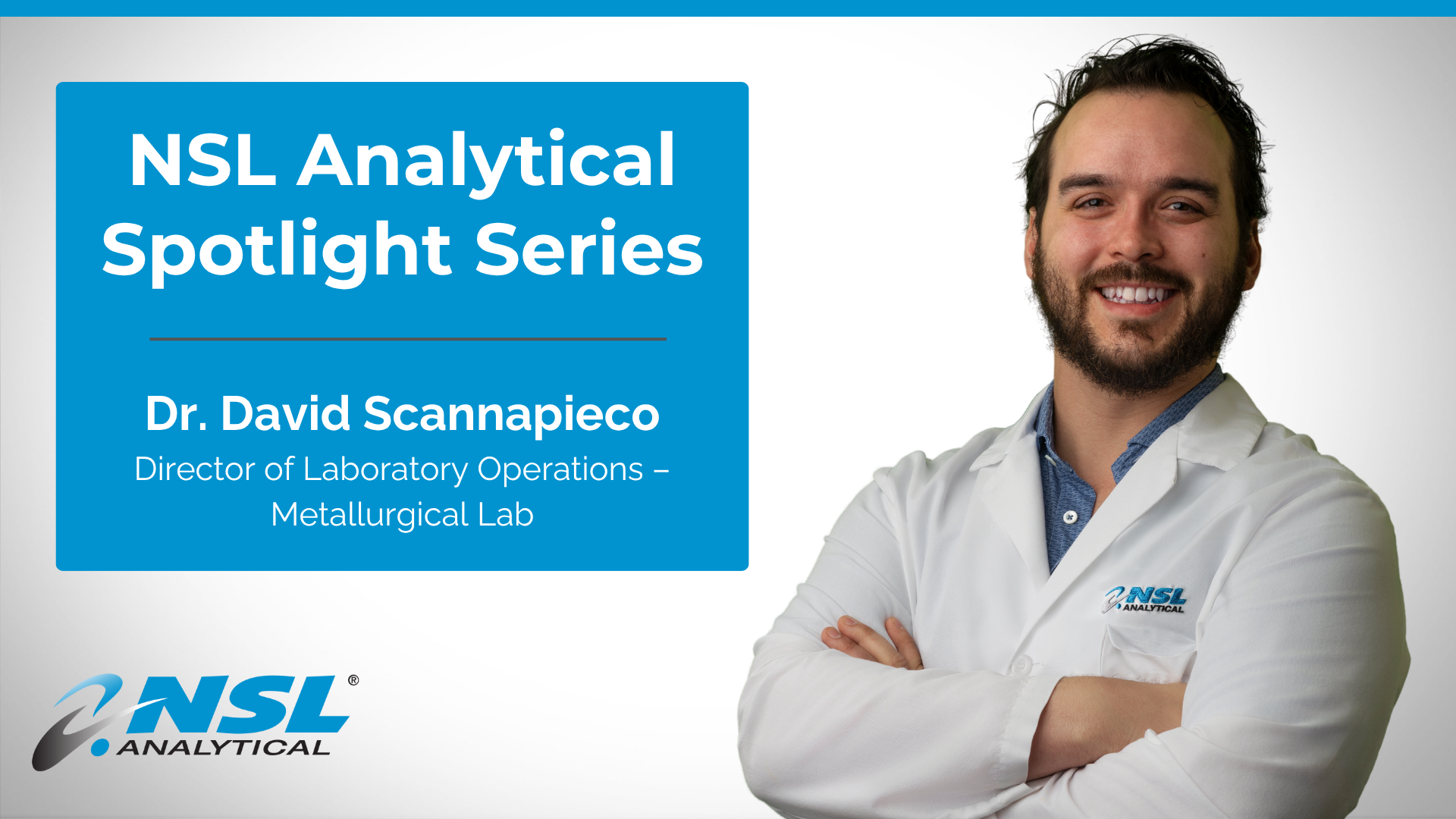
Sometimes the right path finds you, not the other way around. Such is the case for the career built by Dr. David Scannapieco, Director of Laboratory Operations for NSL’s Metallurgical Lab.
His fascination with metallurgy dates back to his high school days, when he became curious about why bicycles with a carbon fiber frame might be more advantageous – and more expensive – than those made from steel.
That deep-rooted interest in materials science grew during his undergrad time at Case Western Reserve University. It continued through his intensive studies pursuing his Ph.D. to his current role at NSL Analytical, where Dr. Scannapieco is no stranger to creatively improving processes, challenging the status quo (within reason, of course), and having a spreadsheet for, well, everything.
For the newest post in the NSL Analytical Staff Spotlight Series, we sat down with Dr. Scannapieco for a spirited conversation about how he got started in metallurgy, the qualities needed to lead a technical lab and the future of 3D printing in the manufacturing industry.
Hello David! Thanks for taking some time today! Tell us a bit about yourself – your background, education and early career before you arrived at your current position at NSL.
I have been in the metallurgy space my entire career. During my undergraduate time at Case Western Reserve University, I already knew materials science would be my focus area. Even as a freshman, I jumped right into research among some amazing projects.
I started out supporting a magnet manufacturing research project – learning how to manipulate magnetic fields by altering the microstructure of the alloy. Manipulating microstructures to acquire certain properties became the focus of my research for the next 10 years.
As a Ph.D. student, my research went beyond microstructures. I studied the process of in situ alloying using 3D printing. Essentially, skipping the traditional alloying steps of making bar stock, plate, or powdered alloys, then 3D printing it.
My research was like taking a bite of all the cake ingredients and having it turn into a whole cake in your mouth. Then, being able to alter each bite so that it is exactly what you want each time.
It’s through this work that I learned the value of testing materials. How we find the properties is as difficult a question as how we make the material the right way.
Through my Ph.D. work, I studied the elemental powder, conducted chemistry testing, powder characterization, microscopy and metallography of the powder. Then I 3D-printed these powders into bulk alloys and conducted testing, including more metallography, tensile, fatigue, creep, and hardness testing. The breadth of my understanding of testing through this work is what led me to accept my first position at NSL.
How did your interest in materials science, specifically metallurgy, come about? Was it something you knew you wanted to do, or did you progress to the field naturally?
Metallurgy was something I stumbled into. I knew I wanted to do materials science from high school. As a high schooler, I competed in triathlons and researched bikes to gain a competitive edge. There I found bikes made from steel, aluminum, and carbon fiber.
My curiosity led me to ask, Why are they different? Why is a carbon fiber bike so much more expensive than a steel bike? It was during college tours that I learned this was an entire field of study – materials science.
From there, I fell into metallurgy because of the versatility. They can be crafted delicately, like a surgical needle, or strong, like tank armor. In my career, I have been lucky to work across the space and let my curiosity run wild with the breadth of questions I handle on a daily basis.
What do you believe is the single most important quality to leading a lab in a highly technical field like metallurgy?
Patience. Definitely patience.
Many key details need to be understood when dealing with anything in this position. Whether it’s people, plans, or testing needs, everyone deserves to be understood and have their concerns and needs addressed. That takes a lot of listening and understanding.
In the lab, it is critical to take the time to do things right. If we make a mistake and need more material from a customer or need to re-heat treat something, that can take days to happen.
Taking 10 minutes to review paperwork or double-check one’s understanding is much less time-consuming than the consequences of days of delay.
As technology continues to advance, what emerging trends or new tech in metallurgy are you most excited about and how might they impact your lab’s future?
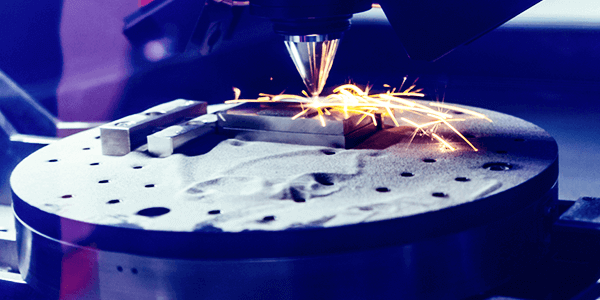
As someone who has done 10 years of research in the additive manufacturing (aka 3D printing, AM) space, I am really excited to see how much AM is being processed in the day-to-day manufacturing industry. It presents an opportunity to reinvent everything, and I mean everything. From the look of different parts, to the function of them, to the alloys we use, really everything is up for grabs and it’s exciting.
One item that our lab will be a part of is the qualification of parts. Like all these other topics, the qualification of AM parts is clearly not going to function the same way we qualify lots of products made from more conventional manufacturing technologies.
The jury is still out on what that new process will look like, but there have been some really creative solutions that will push both manufacturers and labs, like NSL, to miniaturize testing, improve detection levels, add more multi-functional testing, and even things we haven’t considered before.
It’s truly an exciting time to be a part of the AM space!
As a director, what advice would you give to someone just starting their career, or becoming interested in pursuing a career in metallurgy or materials science?
First off, great choice: metallurgy is the best!
In all seriousness, taking ownership of your role has always been something I have valued in myself and in those who work for me. When you are tasked with something, treat it as your own to improve and update (following the proper channels, of course). No one ever knows that test, process, or product better than you in that moment.
Ask questions and challenge the standard process (in the right ways) because often the answer is, “Huh, we never thought of it that way, maybe that would be better.” From there, the world is your oyster!
Outside of work, what interests or hobbies do you enjoy? Do you apply your metallurgical knowledge to any of them, or do you keep the two worlds separate?
Metallurgical expertise is definitely a niche topic. I do apply a lot of my engineering brain to most things I do. Board games, video games, and cooking/homebrewing are definitely my main distractions outside of work.
I’m well known among my friends and family for having a spreadsheet that tracks and optimizes almost everything I spend time on. My fiancée describes my spreadsheets as my own method of “artistic expression,” which I find quite beautiful!
We recently finished renovating our basement to house our wine, whiskey, and board game collections! That’s where we tend to spend a lot of time on the weekends.
This has been fantastic. Thank you for your time and insights, David!
__________________
Looking to explore how third-party testing can support your unique material needs? Check out NSL’s resources below:
Materials Matter: This educational hub page is a trusted resource for material science information.
Webinars and White Papers: Dive into specific topics in this library of educational webinars and white papers.
Video Library: View these helpful videos about everything from additive manufacturing to spectroscopy and more.
NSL Analytical Services, Inc. is an independent materials testing lab that specializes in metallurgical, mechanical, chemical, and optical testing for mission-critical industries.
Contact our experienced, accredited team to discover how we can deliver accurate, repeatable testing results with lightning-fast turnarounds, giving you confidence in your material performance and adherence to quality standards and regulations.
Dr. Ross Cunningham has more than a decade
Dr. Ross Cunningham has more than a decade
Ben Pratt is the Business Development Manager –



NSL Analytical
4450 Cranwood Parkway
Cleveland, OH 44128
(216) 438-5200
(216) 438-5050
NSL Metallurgical
4564 Johnston Parkway
Cleveland, OH 44128
(877) 560-3943
NSL Analytical
4450 Cranwood Parkway
Cleveland, OH 44128
(216) 438-5200
(216) 438-5050
NSL Metallurgical
4564 Johnston Parkway
Cleveland, OH 44128
(877) 560-3943