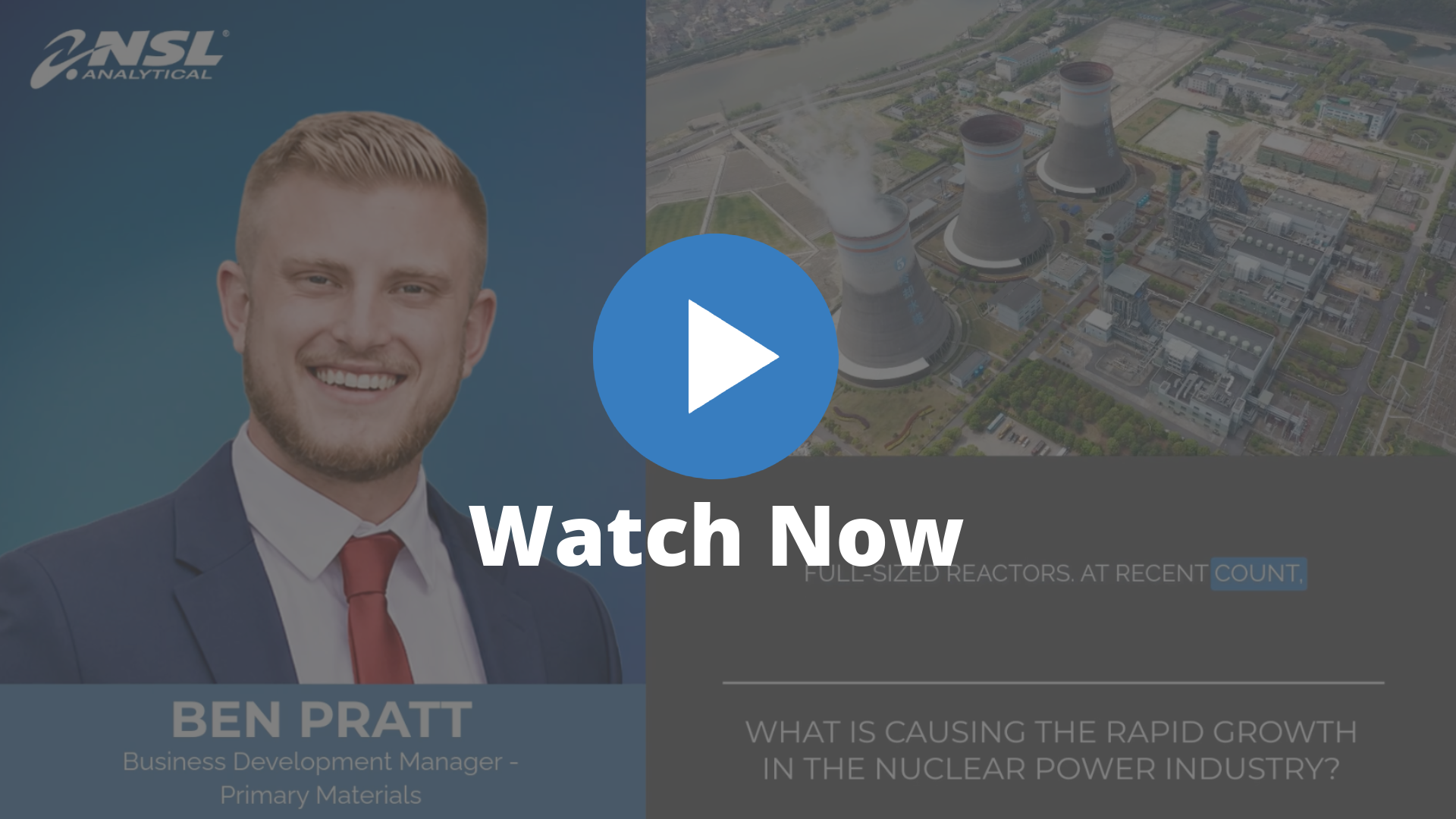
Ben Pratt is the Business Development Manager – Primary Materials at NSL Analytical. He holds a B.S. in Physics from Marietta College and an M.S. in Physics from Case Western Reserve University. He can be reached at bpratt@nslanalytical.com.
With the resurgence of nuclear power driven by rapid growth in AI, data centers and other technologies, the need for reliable power and long-term electrical stability is clear. For that reason, the right QA system and capacity to scale in parallel with industry demands are critical for nuclear materials testing.
In this Q&A, Ben Pratt, Business Development Manager – Primary Materials, talks about the importance of long-term domestic supply chains for the nuclear industry and the value that a single lab with the expertise, quality system, capacity and critical materials testing capabilities provides to nuclear operations.
To listen to Ben’s answers, click here to hear the interview.
____________________________
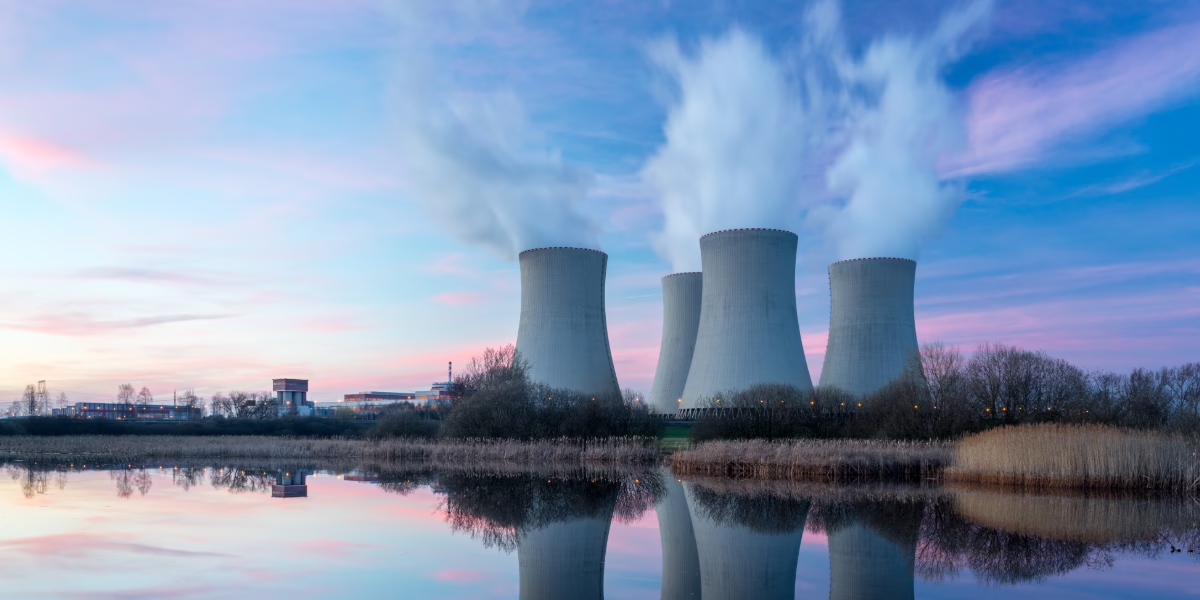
Nuclear energy has become a uniquely bipartisan issue in the U.S., driven by three key factors.
The first one being rapid growth in data centers, AI, and advanced computing. The second being the need for reliable baseload power to support grid stability and, as well, complement renewables. And then finally, the third point would be the rising long-term electricity demand driven by those above factors, but just in general as a more manufacturing-focused society.
To scale nuclear at the pace needed, the U.S. is going to have to rebuild a strong domestic supply chain for that sector. From fuel and advanced materials to the testing required to qualify them, all three of those are absolutely critical.
The Department of Energy, to respond to that, is investing heavily in reactor restarts, uprates, and life extensions to the tune of nearly $20 billion dollars.
So to go into those three in a little more detail:
First of all, restarts. There are two core or key examples of them: the first being the Palisades in Michigan is being restarted by Holtec and is expected to operate through at least 2051. And then the former Three Mile Island Unit 1 is now being restarted under the name Crane Clean Energy Center.
For uprates, upratings increase the licensed output of an existing reactor without constructing a new one, and a lot of the time this can reach up to the point of a 20% increase in total output. Additionally, this program has started—and did start—in 1977. Uprates have added generating capacity roughly equivalent to several full-sized reactors. At recent count, I think it’s 5 or 6 total full-sized reactors that uprates have avoided the construction of.
And then finally, life extensions. As the name implies, these reactors were originally licensed for 40 years, but through a life extension, they can operate well into several decades past that, so long as you’re getting through refurbishment and relicensing.
And then there’s kind of a fourth point here, which is the Small Modular Reactors that are kind of the next generation of nuclear reactors that are coming online. So the U.S. is investing in these SMRs—Small Modular Reactors—which use smaller, standardized designs intended to reduce capital requirements and enable more repeatable manufacturing.
Together, these four points—restarts, uprates, life extensions, and these SMRs—offer a much more efficient way to expand our nuclear capacity while strengthening the domestic nuclear industrial base.
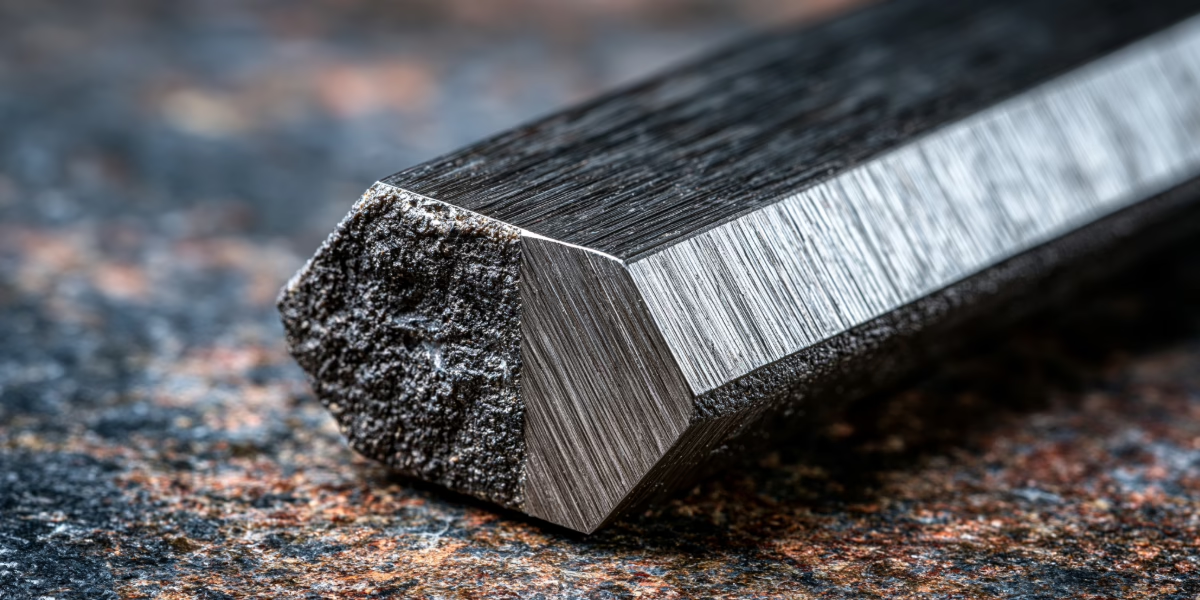
Nuclear conversations often start with fuel, but boron-based materials are also critical to reactor safety and control.
If enriched uranium, which is the fuel, is kind of the gasoline to your car, boron is part of the brakes and the steering system, right? So there are kind of two separate systems. Power is only useful if you can safely control it. You wouldn’t necessarily want to get into a car that you can’t brake or control, even if it has a huge engine in it.
When we talk about boron, boron has two main isotopes: B-10 and B-11. B-10 strongly absorbs neutrons, allowing operators to control reactor reactivity, while B-11 is comparatively inactive in that space and is not necessarily required.
B-10-containing materials are commonly used in control rods and neutron absorbers, dissolved boric acid in some form of reactors, which they use for reactivity control, as well as emergency shutdown systems using highly borated water, and then finally neutron shielding and criticality control materials.
There’s an honorable mention here within boron materials, which is enriched and borated steels. These are commonly used in spent-fuel storage and other criticality control applications.
Precision matters with B-10 because it’s expensive. Too much enrichment unnecessarily increases your component costs, while too little can leave the component underdesigned for its neutron control function.
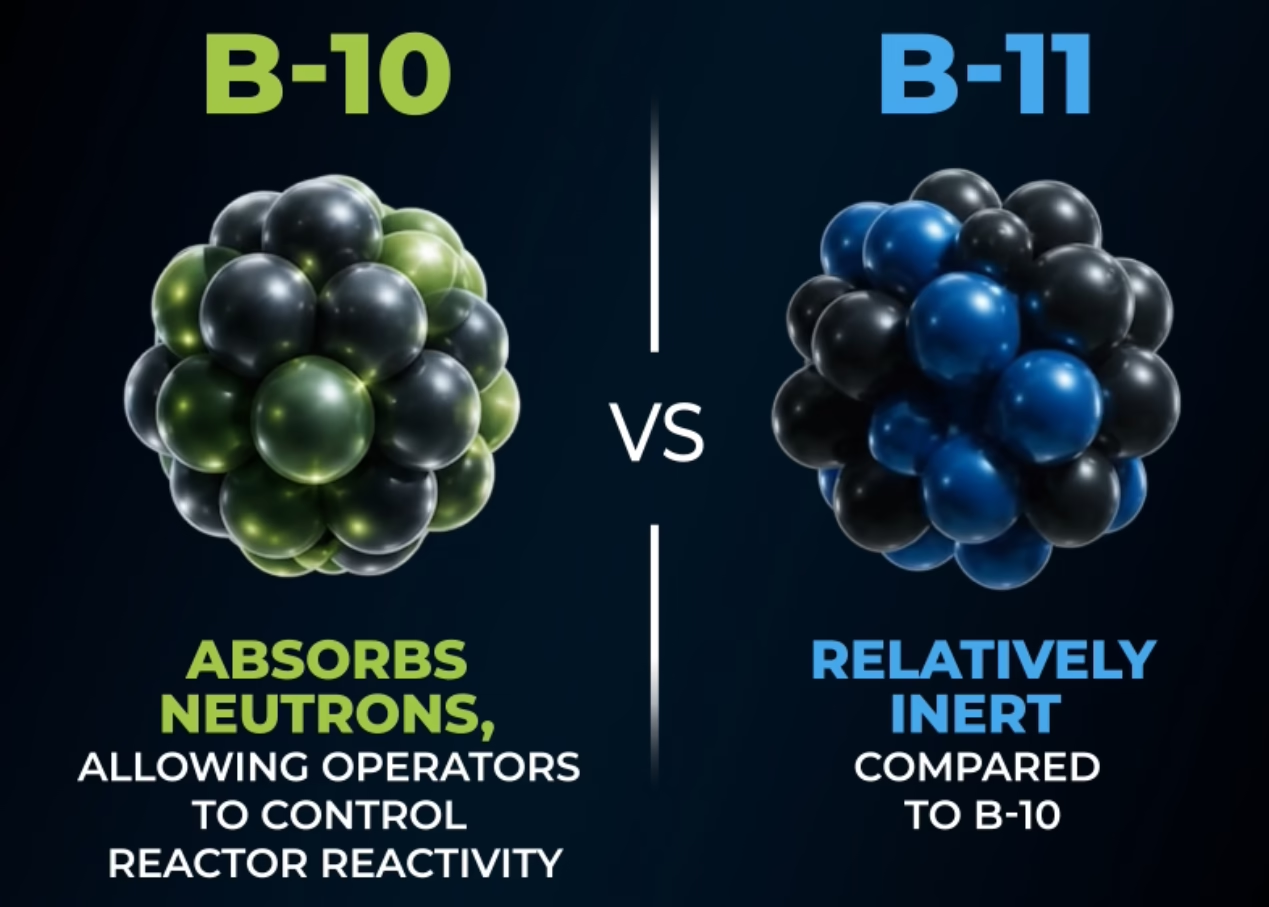
Because B-10 enrichment is so important for criticality and the safety aspect, this testing has really evolved over time.
There are two separate measurements that can help you with the chemical composition and isotopic composition: first of all, there’s the elemental content. So, bulk boron content is measured with NSL’s core wet chemistry and spectroscopy methods.
How we do that is with a mass spectrometer. So B-10 and B-11 are chemically identical, but differ in atomic mass. So, mass spectrometry (ICP-MS) separates and measures the ions by mass-to-charge ratio, and that helps us resolve the two isotopes and can help us quantify the abundance.
The differentiator, so isotope ratio mass spectrometry, is a niche, high-precision capability that not every commercial lab offers. NSL was the first commercial lab in the US to offer ICP-MS testing back in the ’90s. And an additional point there is that NSL Analytical has been around for over 80 years.
And then the final point is that NSL is an NQA-1 compliant lab that serves customers throughout the entire nuclear power generation value chain.
So let’s start with the first question: What is NQA-1? ASME NQA-1 is a quality assurance requirement program for nuclear facility applications. It’s a formal quality assurance program standard built around 18 criteria governing how work is planned, documented, and controlled—not just a certificate on the wall.
Now, when is this required? NQA-1 is required of organizations supplying safety-related items, services, and qualification data to NRC-licensed nuclear facilities. It’s the accepted way to demonstrate compliance with 10 CFR 50, Appendix B, and it also covers 10 CFR 21, which is for defect reporting.
And then finally, why is it critical to scaling safely? As new builds, restarts, uprates, and even the SMRs move forward, the volume of components and materials needing safety-related qualification data is growing rapidly. NQA-1 compliant labs are one of the few vendor types equipped to supply that data at the pace and rigor regulators require. Without the certification, a lab can’t touch the safety-related supply chain at all.
Now, why is NSL built for the scale-up? As these supply chains rebuild, NSL is already operating as a high-throughput production support partner, not just a one-off qualification shop. And we have the capability and the capacity to scale alongside the industry demand and keep customer projects on schedule.
Nuclear quality assurance requires more than an accurate test result. Manufacturers need defensible data, full traceability and documentation that meets nuclear quality requirements.
So, NSL combines: one, an NQA-compliant quality program; two, more than 80 years of analytical and materials testing experience; three, specialized isotope ratio testing – including B-10 and B-11; four, chemical, metallurgical and materials characterization capabilities under one organization. And finally, the experience across the nuclear power supply chain.
That breadth allows customers to use one laboratory for alloy chemistry, mechanical qualification, isotopic analysis and other critical materials testing.
We’re built for recurring production work, not only one-off development programs. And as the nuclear manufacturing ecosystem scales, testing cannot become the bottleneck. NSL provides the technical expertise, quality system, capacity and turnaround times needed to keep critical materials moving through the supply chain.
The nuclear industry is rebuilding a domestic supply chain designed to operate for decades. NSL is positioned to help ensure the materials entering that supply chain are ready for the job.
So as a broader outlook, as we look toward the nuclear resurgence, this looks much less like a short-term cycle and much more like the beginning of a long infrastructure buildout. The next decade will likely be defined by extending the life of the existing fleet, bringing the next wave of SMRs online, and rebuilding the domestic fuel, materials, and component supply chains needed to support both. The companies that can consistently meet nuclear quality requirements will become increasingly important as that ecosystem scales.
________________________________
Looking to dive deeper into how third-party testing can support your unique material needs? Check out NSL’s resources below:
Materials Matter: This educational hub page is a trusted resource for material science information.
Webinars and White Papers: Dive into specific topics in this library of educational webinars and white papers.
Video Library: View these helpful videos about everything from additive manufacturing to spectroscopy and more.
NSL Analytical Services, Inc. is an independent materials testing lab that specializes in metallurgical, mechanical, chemical, and optical testing for mission-critical industries.
Contact our experienced, accredited team to discover how we can deliver accurate, repeatable testing results with lightning-fast turnarounds, giving you confidence in your material performance and adherence to quality standards and regulations.

On October 6, 2025, NSL’s Dr. Ross Cunningham
Sometimes the right path finds you, not the
A lot has changed in the past 18



NSL Analytical
4450 Cranwood Parkway
Cleveland, OH 44128
(216) 438-5200
(216) 438-5050
NSL Metallurgical
4564 Johnston Parkway
Cleveland, OH 44128
(877) 560-3943
NSL Analytical
4450 Cranwood Parkway
Cleveland, OH 44128
(216) 438-5200
(216) 438-5050
NSL Metallurgical
4564 Johnston Parkway
Cleveland, OH 44128
(877) 560-3943