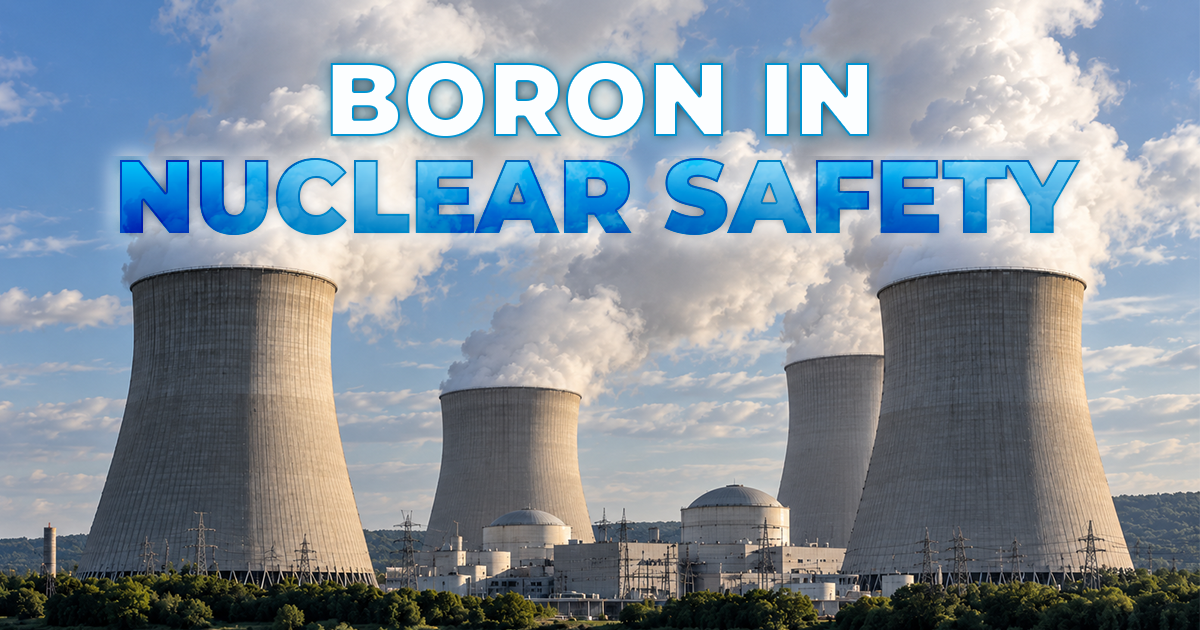
Boron-based materials are critical to nuclear reactor safety and control. Discussions about nuclear power often focus on the fuel that powers reactors, but that power needs guardrails to be safely contained.
This is where boron comes in.
If you think of enriched uranium as the gasoline in your car, then boron is part of the brakes and the steering system.

Essentially, boron absorbs free neutrons without starting nuclear fission, which helps control nuclear reactions. This absorption capability comes from the Boron-10 (B-10) isotope, which requires precise enrichment to balance cost and function.
Boron has two main isotopes relevant to nuclear production: B-10 and Boron-11 (B-11). The two isotopes are nearly identical chemically but differ significantly in their nuclear and physical properties, which help determine how they are used in nuclear applications.
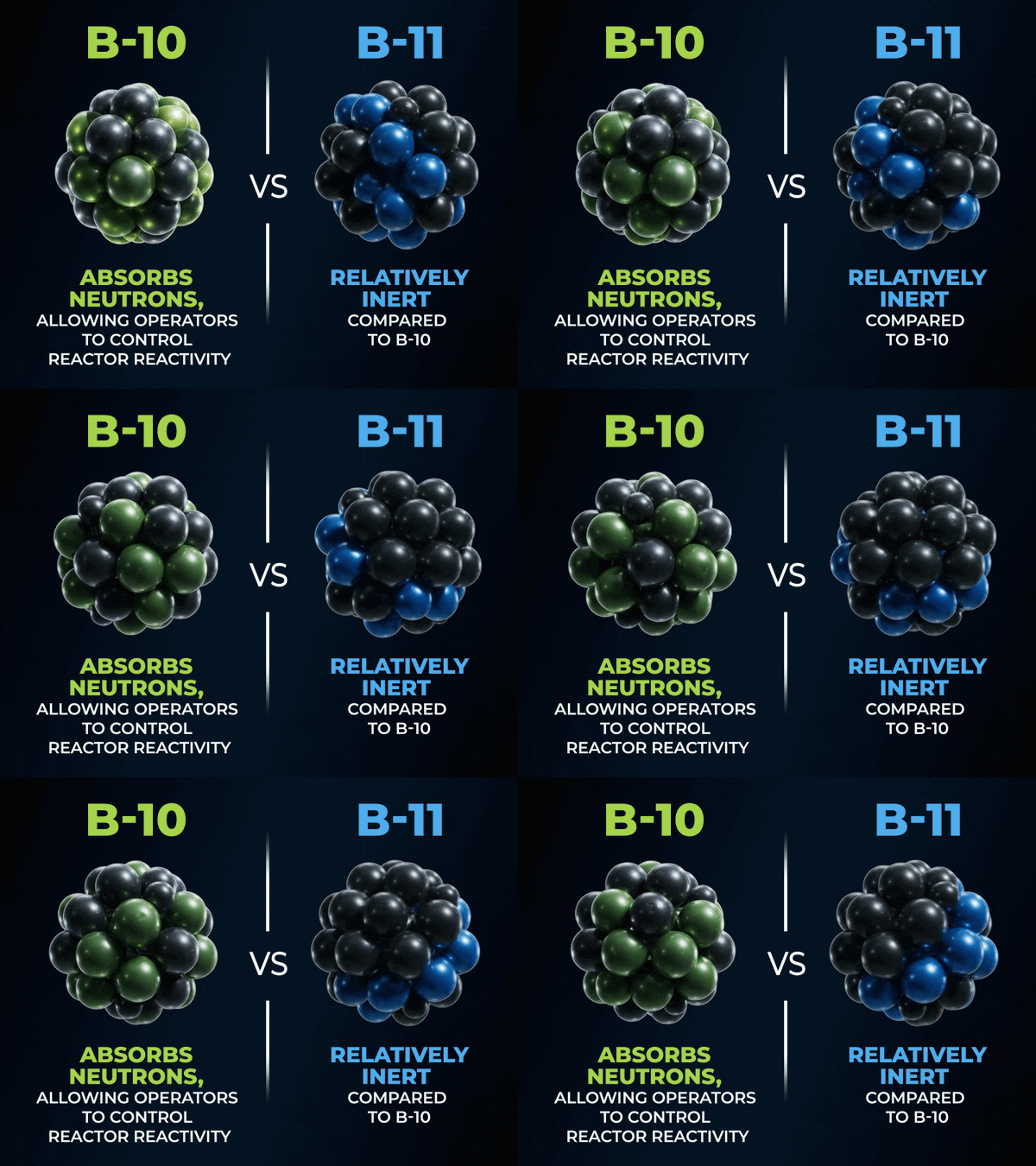
B-10 materials are typically used in control rods, neutron absorbers, emergency shutdown systems, and radiation shielding. Conversely, B-11 allows neutrons to scatter. These materials are commonly used in specialized nuclear applications.
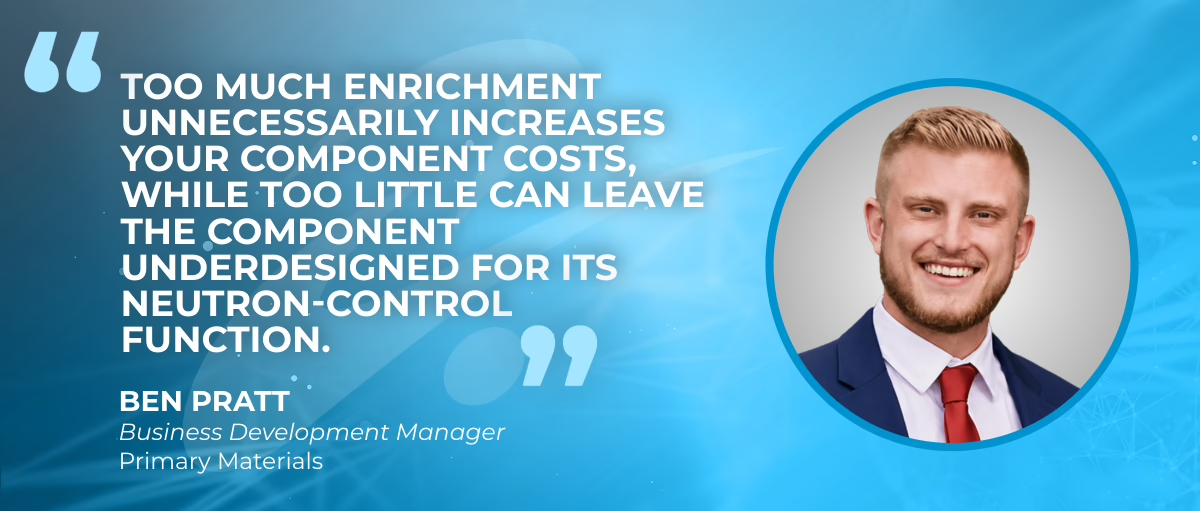
Because B-10 has a far higher neutron-capture cross-section than B-11, it is particularly sensitive to thermal neutrons. This means precision in the enrichment ratio is critical. Even minuscule errors in concentration or measurement can have significant, expensive downstream effects during manufacturing.
This is where an independent lab like NSL Analytical provides immense value to nuclear manufacturers.
As an independent, NQA-1-compliant lab, NSL has the capacity and technology to ensure boron-containing materials are qualified for nuclear applications. That’s because NSL has proven capabilities in advanced isotopic and chemical analysis, metallurgical, and mechanical testing.
For a deeper dive on the role of Boron isotopes in nuclear applications and the resurgence of nuclear power, watch this interview with Ben Pratt, Business Development Manager , at NSL Analytical. The video covers the resurgence of the nuclear industry and how the right lab with scalable testing capacity can keep nuclear materials production moving at scale.

The nuclear power industry is experiencing a renaissance
Dr. Ross Cunningham has more than a decade

Dr. Ross Cunningham has more than a decade



NSL Analytical
4450 Cranwood Parkway
Cleveland, OH 44128
(216) 438-5200
(216) 438-5050
NSL Metallurgical
4564 Johnston Parkway
Cleveland, OH 44128
(877) 560-3943
NSL Analytical
4450 Cranwood Parkway
Cleveland, OH 44128
(216) 438-5200
(216) 438-5050
NSL Metallurgical
4564 Johnston Parkway
Cleveland, OH 44128
(877) 560-3943